
Tianqiao Chen
I. Human evolution has never stopped; it has only changed its method
After Homo sapiens, our bodies have barely changed. There is even research showing that the human brain's volume has shrunk compared to the Paleolithic era. But this does not mean human evolution has stopped. We used our intelligence to make scientific discovery and technological invention our new, external evolutionary organs. We invented weapons to grow claws and fangs, invented clothing to grow new skin, invented cars to outrun cheetahs, and invented airplanes to surpass birds. Our average lifespan has extended from our twenties to nearly eighty years—a gap that biologically exists only between different species.
It can be said that humanity has not stopped evolving; rather, by continuously discovering the unknown, we have externalized our own functions, expanding our scope in time and space. It can be said that scientific discovery and technological invention have become the main engine of human evolution.
II. "Discoverative" Al is Artificial General Intelligence in the truest sense
Therefore, "Al for Science" should not be just one direction for Al application. It defines the relationship between Al and humanity: The value of Al is not the replacement of existing human work-for example, being faster, cheaper, or more efficient. From the perspective of our species' evolution, Al for Science is Al for Human Evolution. Helping humanity discover the unknown is the ultimate value of Al to humankind.
Of course, many models today claim to have "discovered" new structures, new molecules, or even new theories. But this "discover" still largely remains at the level of results. They have found new samples within known energy functions, statistical patterns, or corpus distributions. This is not discovery in the scientific sense; it is extrapolation within a search space.
True "discover" is the ability to pose problems, not just answer them; to understand principles, not just predict results.
This form of intelligence-which can actively construct testable theoretical models (testable world models) about the world, propose falsifiable hypotheses, and continuously correct its understanding framework through interaction with the world and self-reflection-is the only true Artificial General Intelligence.
We call this "Discoverative Intelligence."
It differs from other definitions of intelligence:
It transcends imitation, because creation and discovery are the essence of wisdom;
It is falsifiable, because discovery is an observable event, not a vague philosophical definition like "consciousness";
It reframes the meaning of AGI-not to "replace humanity," but to "continue humanity."
III. The Scaling Path and the Structure Path: Two Roads to "Discoverative" Al
With "Discoverative Intelligence" as our new standard, let's re-examine the two schools of thought for developing Al today:
 | The first is the "Scaling path." It emphasizes that parameters are knowledge, and intelligence is a product of scale. This view believes that as long as the model is large enough, the data sufficient, and the compute powerful enough, intelligence will naturally emerge. This path has already yielded astonishing application results, enabling Al to predict proteins, generate chemical compounds, and even assist in scientific research. This is undoubtedly the most successful engineering path in Al history. |
Meanwhile, another path is quietly forming: the "Structure path." "Structure" here does not refer to model architecture, but to the "cognitive anatomy" of intelligence. The brain is a system that, through neural dynamics, and based on memory, causality, and motivation, forms a knowledge system that continuously evolves over time. These mechanisms endow intelligence with continuity, interpretability, and a sense of direction. Because the essence of scientific discovery is to deduce the future, this view holds that only an intelligence with temporal structure can remain valid out-of-distribution. In the past, our understanding of the brain was too superficial, and our computational tools too primitive, making attempts to imitate the brain fraught with difficulty. But today, breakthroughs in neuroscience and the engineering capabilities of modern Al have, for the first time, given us the opportunity to truly combine the brain's "temporal structure" with powerful "computational scale." This is a historical opportunity that our predecessors did not have. | |
IV. A Mirror of the Brain: Analysis of Temporal Structure
So, what exactly do we mean by the "brain's temporal structure"? It does not refer to a specific physical region of the brain, but to the brain's fundamental "operating paradigm" for processing information. The "spatial structure" paradigm of current Al (Scaling) is, in essence, "instantaneous" and "static." It uses massive spatial parameters to fit a "snapshot" of the world. But the brain's "temporal structure" paradigm is, in essence, "continuous" and "dynamic." Its purpose for existing is to manage and predict information in the flow of time. And for a system to manage information in the flow of time, it must, by logic, possess five capabilities. These five capabilities together form the complete loop of "temporal structure":
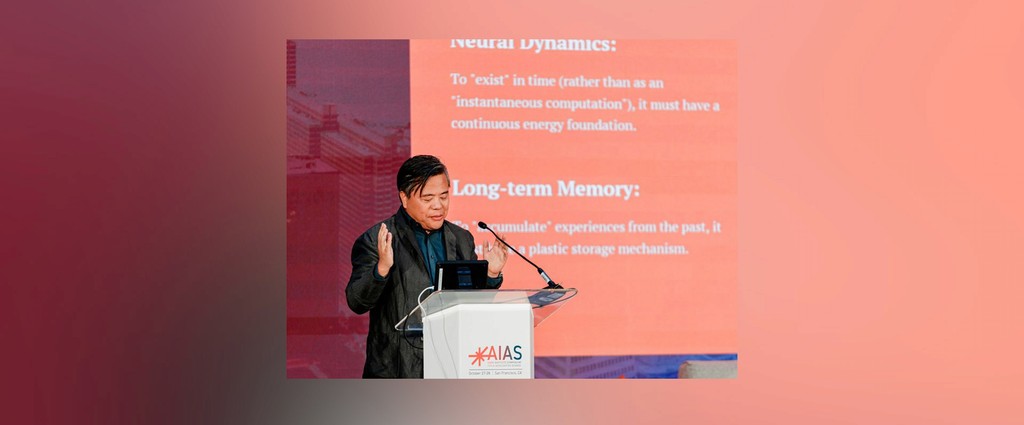
Neural Dynamics: To "exist" in time (rather than as an "instantaneous computation"), it must have a continuous energy foundation.
The human brain is a continuously running, dynamic energy system. Even without input, the brain is self-organizing, self-activating, and self-correcting. This continuous flow of energy makes intelligence truly "alive." Just as when the human brain is idle, internal thoughts are still flowing, colliding, and generating new inspiration. The Transformer, however, is a discrete, static computational graph. Every time an inference ends, its "thinking" stops completely, and the next time begins from zero. It has no temporal continuity. Today's intelligence is just a computation, not an existence. And wisdom must be "alive" because the world is always in flux. Only a system that continuously updates in time possesses the capability for scientific discovery.
Long-term Memory System: To "accumulate" experiences from the past, instead of starting from zero every time, it must have a plastic storage mechanism.
The memory of current large models is "short-term working memory." Once the context is cleared, the intelligence is reset. Without long-term memory, there is no true learning. Long-term memory not only allows intelligence to accumulate experience, but more importantly, it allows it to learn to forget selectively, enabling effective learning within limited parameters, and allowing it to form hypotheses and theories.
Causal Reasoning Mechanism: To "understand" the order of events in time (i.e., what causes what), it must be able to deduce principles.
Existing large models' understanding and reproduction of known information, including causality, is still limited to linguistic statistics within a known range, not a deduction of mechanisms. The model performs perfectly within the distribution of its training data, but once the environment changes, its performance collapses. This is because it relies on co-occurrence patterns, not the world's structure. The significance of causal reasoning in scientific discovery is precisely to re-establish an understanding of the world under unknown conditions. It is the first step toward going out-of-distribution and the starting point for a world model.
World Model: To "predict" the trajectory of the future, it must be able to internally simulate the world.
Although current Al has multimodal perception, it still lacks a unified model, unable to form a coherent "projection of reality" internally. The human brain, however, possesses a unified system for world representation, integrating perception, memory, prediction, and self-reflection. It allows us to internally simulate the world and preview the future, continuously running hypothesis testing and causal predictions about the world at a neural level. This is the essence of scientific thought: running an experiment about the future, inside the brain.
Metacognition & Intrinsic Motivation System: To "manage" all the complex, cross-temporal processes above.
The human brain possesses metacognition-the ability to be aware of its own uncertainty, adjust reasoning paths, allocate attention, and select strategies. This "thinking about thinking" is the starting point of science and creativity. Yet Al today still relies mainly on external instructions, lacking self-drive. When long-term memory and causal reasoning converge within the world model, they will naturally give rise to machine metacognition: Intrinsic motivation will no longer need to be programmed. Curiosity and the desire to explore will be spontaneously generated. This is the hallmark of "living intelligence," and the critical step from being a passive executor to an active explorer.
These are not five parallel directions, but a continuous, living loop of intelligence-a system that can self-evolve in time. I call this "Structured Temporal Intelligence."
Here, I must emphasize: The paths of scale and structure are not mutually exclusive. More precisely: Structure is the steering wheel; scale is the engine. Structure provides the correct direction and framework for the development of intelligence, while scale provides the necessary power. The purpose of my proposing these two paths is to distinguish: Do we believe that these five structural capabilities are a natural emergence after extreme scale, or are they a necessary prerequisite before achieving "Discoverative" Al? The former sees these five capabilities as the "end point of scaled intelligence," the effect. The latter believes these five capabilities are the cause, a prerequisite for intelligence that must be actively constructed.
We believe that Structured Temporal Intelligence is the necessary path to achieving "Discoverative" Intelligence. This path, though it appears more winding and complex, has clearer implementation goals and a clearer path to realization. Furthermore, it allows the "black box" of intelligence to gradually become interpretable, making it most likely that human intelligence and artificial intelligence, sharing a common origin, can become collaborators in exploring the unknown. What's more, even if this exploration fails, it is a necessary process for us to understand human intelligence. And understanding the intelligence of the human brain is the very reason TCCI was founded.
V. Structured Temporal Intelligence: The Entry Point for the Young
It is precisely because of the immense success of the Scaling path in recent years that we can, for the first time, see its ceiling so clearly: a barrier on the way to true understanding and discovery that cannot be broken by piling up data and compute alone. This is the best opportunity for the return of structuralist thinking. We are standing at this historical turning point. What we need are not more graphics cards, but new theories, new algorithms, and new imagination. It requires interdisciplinary thinking—a fusion of neuroscience, information theory, physics, and cognitive psychology. These are precisely the advantages of the young.
We have already prepared for these young people:
We have compute. No matter which path is taken, compute is indispensable. We will invest over one billion US dollars in a dedicated compute cluster to provide young scientists with a resource environment for immediate experimentation. This compute power is not for competing on scale, but for exploring structure-validating a new memory mechanism, a new causal architecture, or a new neural dynamics hypothesis.
We have offices. We have established research offices in Silicon Valley, Tokyo, Beijing, Shanghai, Hong Kong, and Singapore, and are preparing to build centers in Toronto and Europe. We require young researchers from different disciplines to collide their intellects in-person at the same whiteboard. Already, more than 200 PhDs from world-renowned
We are building a benchmark. We plan to launch a complete STI Benchmark to comprehensively measure neural dynamics, long-term memory, causal reasoning, world models, and metacognition, using whether Al is "Discoverative" as the standard for measuring AGI. We will then let all scientists collaborate and compete based on SOTA goals.
We have a mechanism tailored for the young. We are establishing a PI Incubator, opening an independent research track for young global scientists. PhD students and postdocs, without needing to wait for graduation, can receive an independent budget, build a lab named after themselves on our platform, and lead their junior colleagues to independently explore the future structure of temporal intelligence. We believe: Scale is the path of giants; Temporal Structure is the opportunity for the young. Giants use compute to push the boundary; the young can use structure to redefine intelligence.

An intelligence that does not repeat existing knowledge, but can instead propose its own hypotheses, validate the world, and correct its understanding.
It is intelligence that can discover!

Tianqiao Chen
Arsenal
Noto Sans SC