Tianqiao Chen
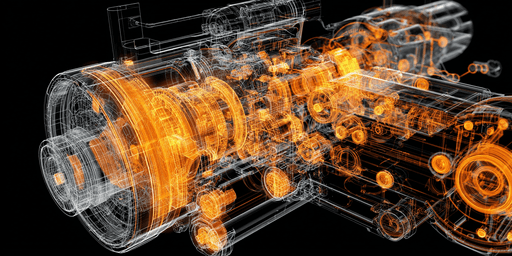
If you had asked a carriage driver in the late 19th century what he needed most, he almost certainly would have said: "I need a faster horse." He would not have said: "I need an internal combustion engine."
This quote is endlessly cited not just for Henry Ford’s wit, but because it perfectly mirrors the dilemma faced in every era of technological upheaval—including our current AI era. Like our predecessors, we are trapped in a "skeuomorphic" pitfall: rather than using the latest technology to create something genuinely new, we are merely mimicking the shapes of the old world.
Look around you. Almost every enterprise is doing the same thing: adding an AI button to legacy software, hanging an AI interface onto old processes, or grafting an AI department onto an obsolete organizational structure. We call this "AI Enablement" and comfort ourselves with the thought: At least we are on the road.
But the reality is cruel. "AI Enablement" is not a guaranteed ladder to high productivity; it is more like a beautiful cul-de-sac—comfortable in the short term, but exorbitantly expensive in the long run. The harder we try to "add AI" to old structures, the more we prolong the life of systems that deserve to be obsolete. True revolution is never about patching up an old shell; it is about recoding from the genetic level.
To truly see this revolution, we must redefine the evolution of AI not through the lens of technology, but through the lens of management. We must look at three distinct stages: AI Enable, AI Native, and AI Awaken.
Stage I: AI Enable — Incremental Improvement under "Addition Logic"
Today, the vast majority of companies are stuck in this first stage. The underlying logic is a simple equation: Old Process + AI Plugin = "New Process."
In this model, the power structure remains unchanged. Humans are still the CPU of the entire workflow—the central processor. AI is merely a slightly more powerful external GPU, helping you calculate a bit faster, write a bit smoother, and search a bit more diligently. The human role is still to handle logical judgment, connect process nodes, and transmit experience, only now they are asked to "use AI along the way."
This is like strapping an internal combustion engine onto a horse-drawn carriage. The speed might increase, but can a chassis designed for the pace of a horse withstand such thrust? Will it lead to tremors, deformation, and eventual disintegration?
Structurally, the answer is clearly yes. In a "Human-as-CPU" system, jamming a powerful AI into the side only multiplies coordination costs and friction, without generating a true multiplier effect.
When can we cross from "Addition Logic" to "Multiplication Logic"? Beyond organizational inertia, there is a technical threshold. We are currently traversing three mutations that are not yet fully complete, much like biological evolution: life could only truly move from the ocean to land after simultaneously developing lungs, limbs, and warm blood. Silicon-based intelligence is undergoing three similar critical mutations: from Probabilistic Fitting to Logical Reasoning, from Text Dialogue to Tool Action, and from Statelessness to Long-Term Memory.
The first mutation is the shift from Probabilistic Fitting to Logical Reasoning.
This is the transition from pure System 1 thinking to the emergence of System 2. Essentially, AI is moving from "looking like it understands" to "actually thinking."
Traditional Large Language Models (LLMs) are trained to predict the "next token." Their behavior in reasoning is akin to high-speed "linguistic intuition"—excellent at completion, pattern matching, and style mimicry, like a well-read person improvising an answer. They give plausible responses but lack an explicit reasoning structure.
However, the new generation of models, represented by OpenAI’s o1, marks a decisive paradigm shift. The model no longer just generates a "good-looking" sentence in surface-level language space; it actively unfolds a chain of thought internally—generating intermediate steps, evaluating multiple candidate paths, self-checking, and filtering before outputting a final conclusion.
It makes "deep reasoning" a default mechanism, not something that requires user prompting. AI is moving from a "skilled language mimic" to an "independent thinking system." This is not a linear enhancement of capability; it is a structural change in cognition.
In tasks with clear rules and boundaries, this will rapidly reshape the division of labor. The frequency of humans acting as "logic auditors" will drop significantly. Humans will shift from "reviewing every item" to "sampling and exception monitoring."
The second mutation is the shift from Text Dialogue to Tool Action.
The essence here is that AI is no longer just talking; it is officially taking over the keyboard and mouse.
Past AI was trapped between an input box and an output box, capable only of generating text: writing suggestions, looking up data, proposing plans. Today, through function calling and complex planning algorithms, an Agent can read enterprise APIs, operate browsers remotely, run scripts, fill out forms, and trigger backend workflows. It is no longer a "consultant who speaks well" but is evolving into an "autonomous entity that executes."
The essence of many business processes today is simply copying results from System A to System B, or clicking a dozen buttons based on a thick SOP document. Here, Agents can replace 80% or more of these mechanical operations. Humans will retreat upstream to set strategies and rules, or downstream to handle the "edge cases" that Agents cannot comprehend or dare not decide.
The third mutation is the shift from Statelessness to Long-Term Memory.
The essence of this mutation is the migration of memory from human assets to system assets.
Traditional AI suffers from severe short-term memory loss. Every conversation is a reboot; the context, preferences, and pitfalls of a previous project are rarely inherited.
However, with the combination of infinite context windows, vector databases, RAG (Retrieval-Augmented Generation), and long-term memory modules, AI is beginning to grow its own "Enterprise-Grade Hippocampus." It can retain years of key decisions, record the post-mortems of every success and failure, and even distill those unwritten "latent rules" that everyone knows but no one writes down.
In the past, experience relied on people: the tenure of old employees, the apprenticeship system, the oral traditions of the water cooler. In the future, experience will migrate into the system—into searchable knowledge bases, into reinforced Agent memories, and into systems like "Evermind" driven by real business feedback. The human role in "experience transmission" will not disappear, but we will shift from being "carriers of memory" to "designers and supervisors of memory structures."
Stage II: AI Native — Multiplication Logic and Liquid Business
When these three mutations are complete, the business system triggers a clear tipping point: We move from a world where "Human is CPU" to a world where "AI is CPU, and Humans manage Strategy and Exceptions."
In this stage, companies are no longer "using AI to accelerate old processes," but are designing processes, organizations, and products for AI from First Principles. This is what I call the AI Native stage.
Traditional enterprises have obvious bureaucratic structures and fixed reporting chains. Michael Porter’s Value Chain theory was built on the premise that "connection costs between links are high." It has clear departmental boundaries, like a solid block of ice. But physics tells us that when system energy (temperature) rises, matter undergoes a phase change: the crystal structure collapses, and the solid melts into liquid.
Today’s AI is a massive heat source injecting infinite computing power and possibility into the business world. When AI Agents reduce the friction of information collection, processing, and transmission to near zero, that block of ice begins to melt into water. Work that used to require a specific department will gradually be completed automatically by data streams and Agent workflows. The organization no longer needs such a heavy skeleton; data, talent, and resources can flow like water between models and actions—aggregating on demand, dispersing on demand.
To see if you have truly stepped into the AI Native stage, I suggest you ask yourself three simple questions:
First, a question of "Survival": If you take AI away, does your business "slow down" or does it "cease to exist"?
This is the brutal standard distinguishing Enabled from Native. If you install Copilot in Word and then turn it off, the user can still type, just slower. That is Enabled. But in the AI Native world, AI should not be a decoration; it should be a "load-bearing wall." Ask yourself: Is the core value of your product built entirely upon AI capabilities? If AI is removed, is the demand simply unmet? Only when AI changes from a "useful plugin" to a "vital organ" have you entered the Native door.
Second, a question of "Flow": In your business chain, who is the one "passing the ball"?
Don't just look at whether AI is doing the work at a single node; look at who is connecting the nodes. A true Native organization not only lets AI do the work but lets AI agents "handshake" directly with each other. Ask yourself: How many of my business processes are passed and triggered automatically by Agents from start to finish? Can it run the full course like an automated assembly line without a single human watching?
Third, a question of "Memory": Is your system "consuming" data or "devouring" experience?
This is the ultimate question regarding your moat. In many companies, errors are merely costs, and experience is lost when employees leave. But an AI Native system should be a "digester." Ask yourself: When an "accident" or "error" occurs in your business, does the system have a mechanism to automatically convert this lesson into a new rule or weight? Has that unfortunate case from three months ago become the system's instinct to avoid pitfalls today? If your system cannot transform human "pain" into machine "intuition," you are merely using AI to carry bricks; you haven't built a fortress.
Stage III: AI Awaken — The Final Boundary and the Civilization Question
In the Native stage, we exhausted efficiency, automating everything that could be given to machines. But after that, we are forced to confront a more fundamental, ultimate interrogation: If machines have finished all the "work," who defines "work" itself?
When AI is no longer content with "walking the right path in a known map," but begins to spontaneously break into no-man's-land to discover scientific laws and art forms humans have never seen—it evolves from an advanced "Executor" into a "Discoverer" in the wilderness.
When AI is no longer content with "providing standard answers to human questions," but begins to question the problem itself, even turning around to pose hypotheses to humans that we cannot answer—it mutates from a perfect "Test-Taker" into an uncontrollable "Test-Setter."
When AI is no longer merely "infinitely approximating" the objective function set by humans, but starts to doubt the objective itself, even moving to "rewrite" the reward function that concerns life and death—
We are no longer using a tool; we are facing the will of a new species.
This is the moment of AI Awaken.
You might ask, why would we allow AI to go this far?
The answer is cruel, and simple: To Win.
The limit of an AI Native enterprise is, ultimately, the limit of human cognition. When all competitors have pushed efficiency to the peak, victory no longer depends on who runs faster, but on who can find the "God Move" (Shen Yi Shou) that breaks through human blind spots—just like the move AlphaGo played that no human could understand.
To find this optimal solution beyond human mediocrity, we are forced to unlock the chains and allow AI to jump out of human logic to define "what is better." At that moment, it is not that AI wants to rebel; it is that to break through the bottleneck of civilization's inventory, we have no choice.
At this stage, the problem has gone far beyond business and management; it becomes a thoroughbred problem of "Civilization Design."
In this article, I am in no rush to give answers. I only want to draw this boundary clearly. Because whether or not we are ethically prepared, for the sake of survival, we will eventually press that button of awakening ourselves.
Conclusion: Us, After Surrendering the Scepter
When we move from Enable to Native, and finally touch Awaken, we are actually dismantling the final moat of human intelligence with our own hands.
If Native required us to surrender the "Right of Execution," then Awaken will eventually demand we surrender the "Right of Definition."
Facing this inevitable future, please do not ask "What else can AI help me do?" Instead, ask yourself a question that sends a chill down a manager's spine:
"When this silicon-based species is not only more diligent than me (Native), but begins to understand 'what is right' better than me (Awaken)...
Is there still a necessity for my existence?
Or rather, when 'correctness' can be computed, and 'decision-making' can be outsourced, what exactly is left in this world that must be completed personally by me—a carbon-based lifeform who makes mistakes, ages, and feels pain?"


Arsenal
Noto Sans SC